Define the wafer before asking for a price
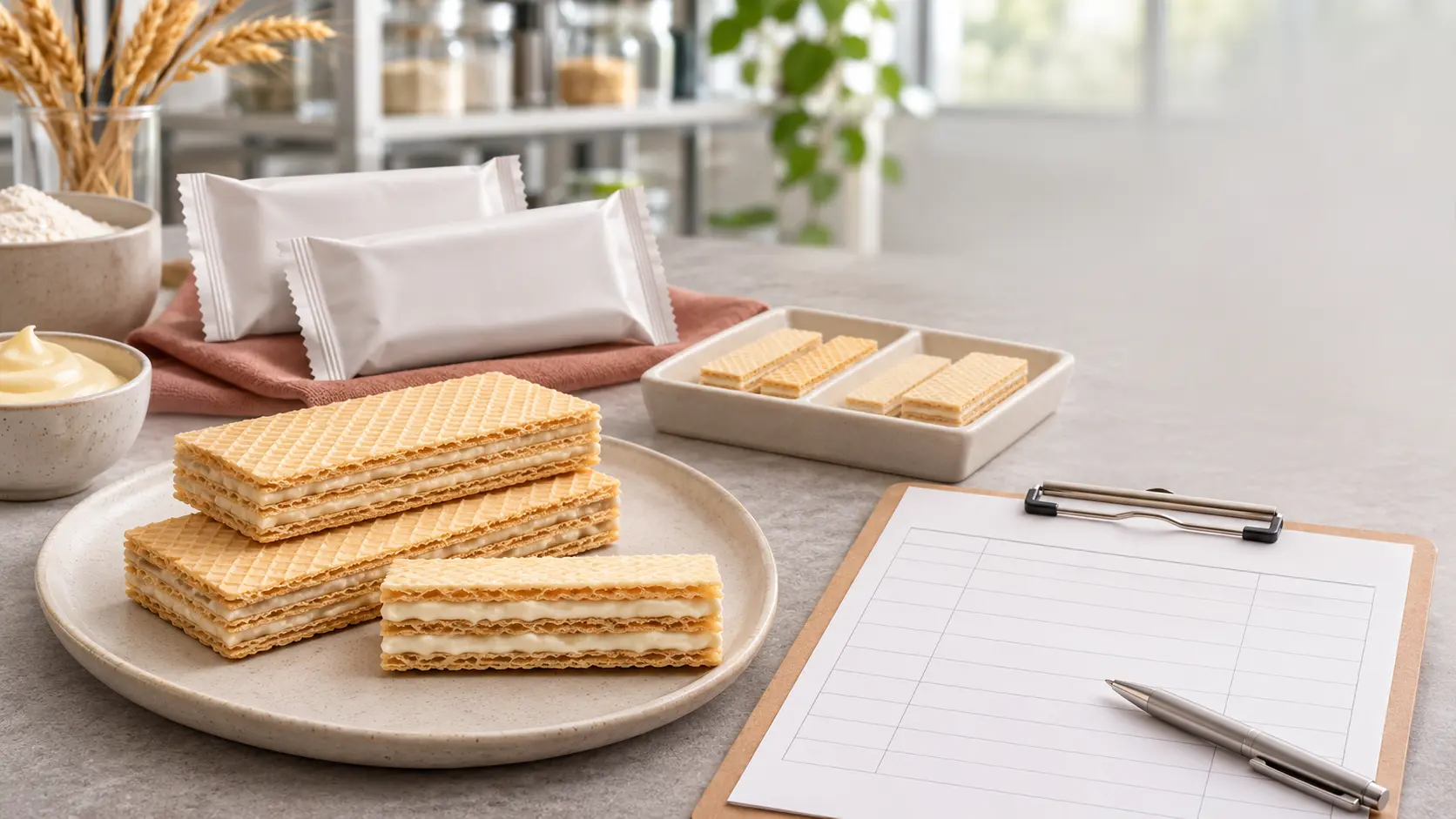
A useful brief starts with the product architecture, not a request for a cheap vanilla wafer. State the number and thickness of wafer sheets, cream-to-wafer balance, piece dimensions, target weight, flavour, colour, surface pattern, coating or uncoated finish, pack count, sales channel and destination. Decide whether the buyer will accept broken pieces within a stated tolerance and how the declared net quantity will be controlled. A reference photo can explain appearance, but it does not replace a measurable specification.
Ask bidders to submit the same sample set and specification sheet. Record piece weight, dimensions, layer alignment, colour, odour, bite, crispness, cream distribution and breakage after transport simulation. Separate the base product from optional cocoa, nut, milk or coated variants. The bakery and pastry buyer page helps frame production questions, while the snacks and confectionery page places the product in its retail category.
Freeze the recipe and allergen map
Request the complete ingredient list, recipe percentages or agreed disclosure level, raw-material specifications, supplier references and permitted substitutions. Wafer biscuits commonly bring together cereal flour, fat, sugar, emulsifiers, flavourings and cream ingredients; the actual recipe may also introduce milk, soy, nuts or other allergens. Regulation (EU) No 1169/2011 requires Annex II allergens used as ingredients to be emphasised in the ingredient list. Confirm the final recipe and cross-contact assessment instead of copying a precautionary statement from another product.
Check each additive against its food category and conditions of use in the EU additives database based on Regulation (EC) No 1333/2008. A substance being authorised somewhere in the Union list does not mean it is permitted at every level in every wafer recipe. Make substitution control explicit: a new fat blend, cocoa powder, flavour, emulsifier or cream supplier can change allergens, nutrition, sensory performance, shelf life, artwork and contaminant review.
Control baking and acrylamide as a process question
Colour and crispness depend on raw materials, batter preparation, plate temperature, time and moisture endpoint. Ask for the proposed process window and in-process checks rather than approving one attractive sample. Regulation (EU) 2017/2158 establishes mitigation measures and a benchmark level of 350 micrograms per kilogram for biscuits and wafers. A benchmark is not a product certification or marketing claim; it is a reference for assessing mitigation and process performance.
The manufacturer should identify the applicable category, document mitigation measures and provide an appropriate sampling and analysis plan. The buyer can request evidence covering representative production, corrective action when results or colour trends move unfavourably, and change review for flour, reducing sugars, raising agents, baking settings or piece thickness. Keep the product-specific plan separate from results for another biscuit.
Protect crispness with the actual pack
Wafer quality can deteriorate through moisture uptake, fat oxidation, flavour migration, seal failure and physical breakage. Specify the proposed primary film, seal format, pack dimensions, product orientation, secondary case and distribution route. Ask for material structure and food-contact compliance evidence under Regulation (EC) No 1935/2004, without assuming one film is suitable for every recipe and shelf-life target.
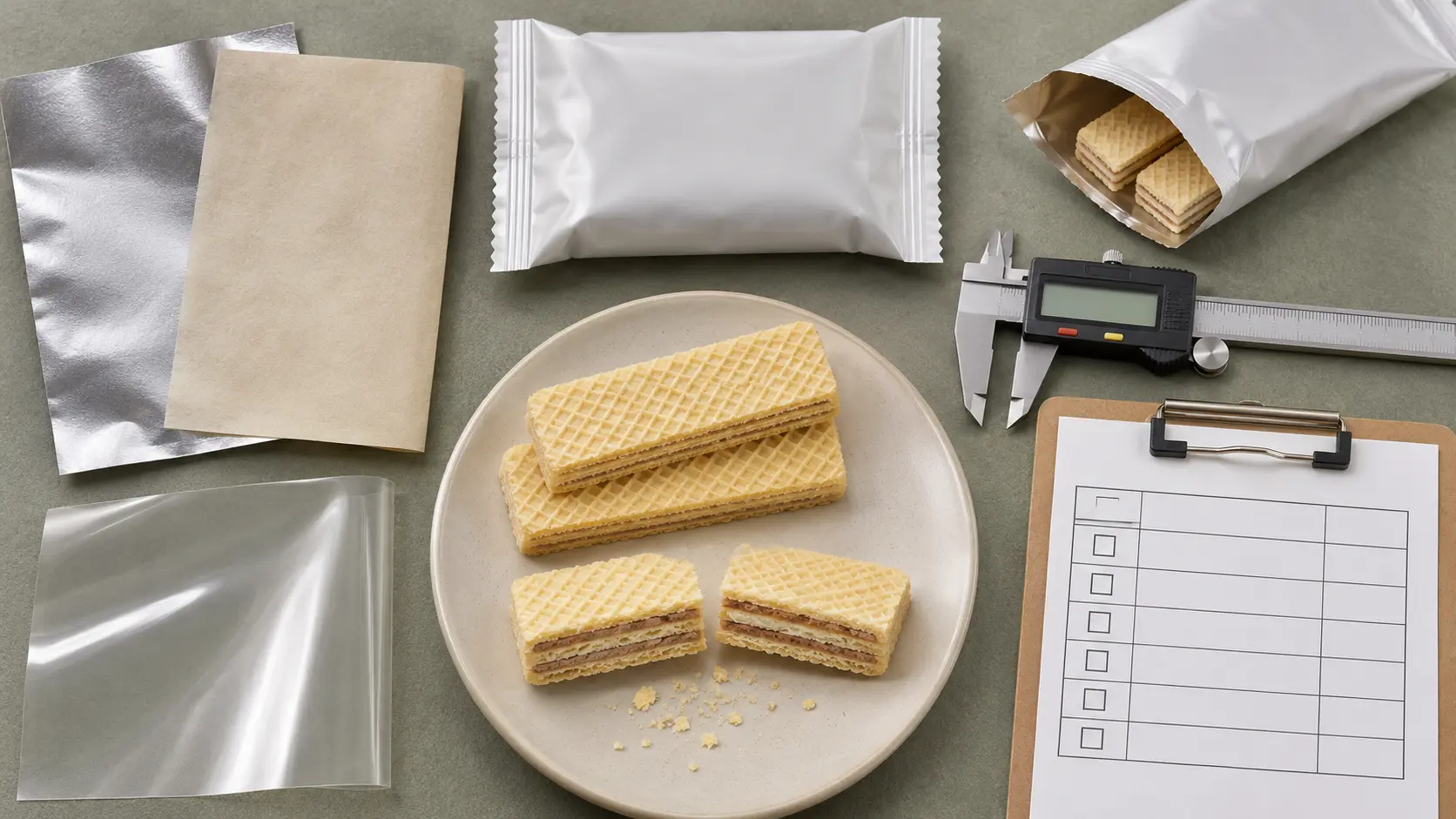
Build shelf-life evidence on the final product-pack combination. Agree storage conditions, checkpoints and acceptance criteria for moisture or water activity where useful, crispness, odour, flavour, rancidity indicators where relevant, seal integrity, appearance, net quantity and breakage. Transport testing should reflect the intended case, pallet and handling route. Accelerated data may support the plan, but it should not be presented as automatic proof of the declared shelf life.
Lock label, claims and traceability before artwork approval
Prepare destination-language artwork from the final recipe and pack. The review should cover the legal name, ingredient list, emphasised allergens, quantitative ingredient declarations where triggered, net quantity, durability date, storage instructions, responsible food-business-operator details, nutrition declaration and lot identification as applicable. Any nutrition or health claim must meet Regulation (EC) No 1924/2006; avoid unsupported wording such as healthy, high protein or no added sugar.
Regulation (EC) No 178/2002 requires traceability through production and distribution. Ask how flour, fats, cream ingredients, packaging and finished cases are linked to the batch, how retained samples and release records are managed, and how a withdrawal or recall would be supported. Contaminant checks should be based on the ingredients and current limits in Regulation (EU) 2023/915, not a generic certificate.
Send one comparable wafer biscuit RFQ
- Destination, channel, flavour, layer structure, piece size, target weight, finish and pack count
- Controlled recipe, ingredient specifications, allergens, cross-contact assessment and permitted substitutions
- Wafer colour, crispness, layer alignment, cream distribution and breakage acceptance criteria
- Baking process window, acrylamide mitigation, sampling, analysis and corrective-action route
- Primary-film structure, seal format, food-contact evidence, case and transport configuration
- Shelf-life protocol, checkpoints, acceptance criteria, retained samples and change control
- Label languages, claims, lot traceability, quantity, delivery place, price basis, minimum order, lead time and exclusions
Require every bidder to complete the same sheet and keep technical acceptance separate from commercial comparison. Use the private-label workflow to assign approvals and the export quote guide to align delivery terms. Send the completed brief through the Marnivo inquiry form for a case-specific sourcing discussion.