
Define the commercial brief before requesting price
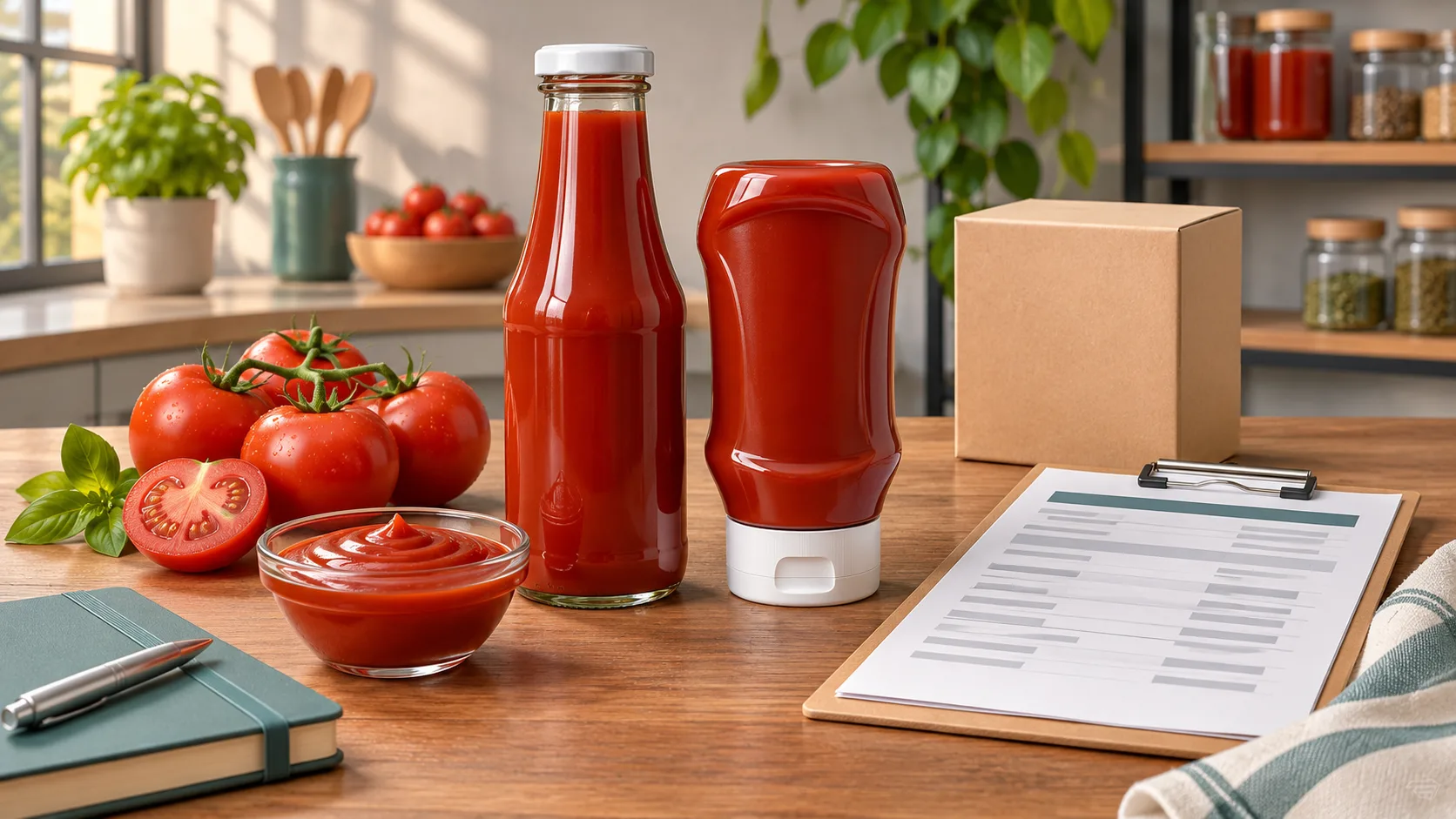
“Ketchup” is not a complete procurement specification. Start with destination markets, retail or food-service channel, target serving use, net quantity, bottle or pouch format, closure, secondary case, planned annual volume and launch timing. State whether bidders should reproduce an approved reference, offer an existing recipe or develop within an agreed sensory and cost envelope. Do not compare a value recipe and a high-tomato recipe as if they were the same product.
Record the tomato statement you expect on pack, target colour and texture, sweetness-acidity balance, spice profile, permitted allergens, nutrition targets and claims that are genuinely required. The sauces and preserves buyer page places ketchup in the wider category; the private-label workflow separates recipe approval, artwork, samples and change control.
Control the tomato input and recipe revision
Ask for a controlled ingredient list, recipe code and revision, tomato ingredient type, supplier and origin policy, incoming acceptance checks, water, sugars, salt, vinegar or food acid, starches, fibres, spices, flavours and any additives. Specify which recipe changes require written buyer approval. A change from tomato paste to another concentration, or a change in starch, sweetener, acid or spice extract, can alter flavour, flow, nutrition and label declarations even when the front panel looks unchanged.
Build measurable release criteria for soluble solids, pH, salt, colour, consistency and net quantity, but do not invent universal values. The buyer and qualified producer should agree the method, sample preparation, temperature, instrument, frequency, tolerance and action rule for the actual recipe. Link the finished-product specification to raw-material requirements, a certificate-of-analysis template, allergen assessment, nutrition calculation basis, shelf-life protocol, traceability plan and signed reference sample.
Test coded samples with one repeatable protocol
Evaluate samples at a fixed temperature and after the same mixing and rest period. Use coded cups and record appearance, tomato aroma, sweetness, acidity, salt, spice balance, cooked notes, aftertaste and any separation. For texture, define a repeatable spoon-flow, line-spread or instrument method rather than relying on “thick” or “premium.” If the product will be dispensed from a squeeze bottle, pump or sachet, test it through that exact pack and serving route.
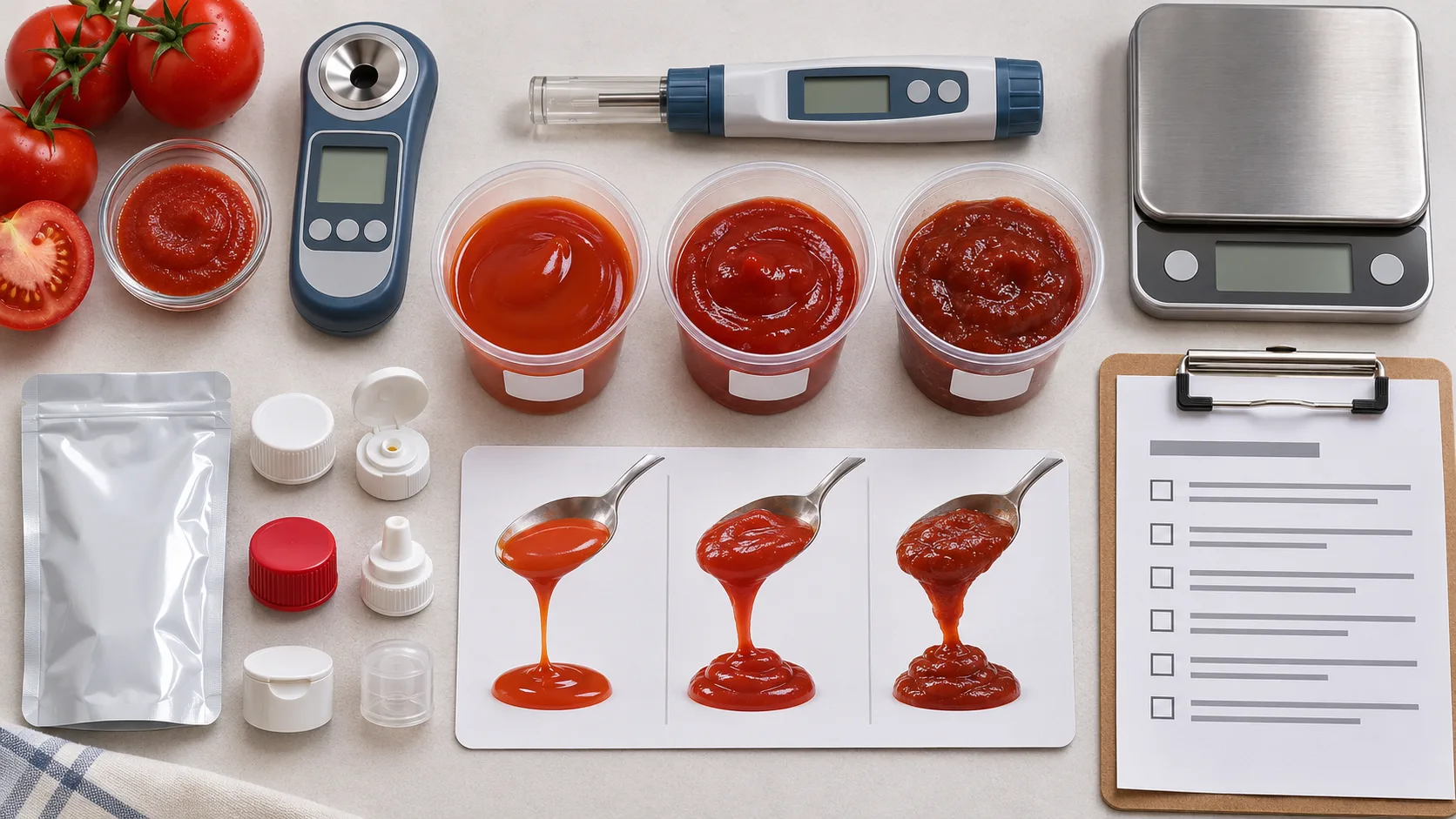
Compare at least the approved fresh sample and samples stored in the proposed final pack under defined conditions. A refractometer or pH meter only produces comparable data when calibration, temperature and preparation are controlled. Keep sensory approval separate from analytical release, packaging performance and commercial comparison; photographs cannot prove stock, certification or continuing conformity.
Review QUID, additives and destination artwork
Regulation (EU) No 1169/2011 sets mandatory food information and requires a quantitative ingredient declaration in specified cases, including when an ingredient appears in the food name or is emphasised by words, pictures or graphics. Confirm how the tomato ingredient is named and quantified, then verify the legal name, ingredient order, allergens, net quantity, date marking, storage, responsible food-business operator, nutrition declaration, destination language and any voluntary origin or nutrition claim before printing.
Regulation (EC) No 1333/2008 governs food additives. European Commission food-category guidance places tomato ketchup among non-emulsified sauces in category 12.6.2. Do not treat that classification as permission for every colour, preservative, sweetener or stabiliser: check each proposed additive and its conditions of use in the current EU rules and database for the exact product. “No preservatives,” “reduced sugar” or similar wording should only be used after the formula and applicable claim conditions are verified.
Validate hygienic control and the product-pack system
Regulation (EC) No 852/2004 requires food businesses after primary production to follow general hygiene requirements and maintain procedures based on HACCP principles. Request the flow diagram and control plan for the proposed line, including ingredient receipt, mixing, heat treatment or other validated preservation step, filling, closure, cooling where applicable, foreign-body control, coding, release and deviation handling. The responsible producer must validate the safe process for the real recipe, pack and shelf life; a generic time or temperature copied from another ketchup is not sufficient.
For the final pack, define material, barrier, closure torque or seal window, tamper evidence, leak method, opening and dispensing performance, coding, case and pallet pattern. Regulation (EC) No 1935/2004 supplies the general EU framework for food-contact materials, while Regulation (EU) No 10/2011 adds specific rules for plastic materials. Obtain declarations and supporting evidence for the actual bottle, cap, liner, pouch or coating and intended use. Verify shelf life on the final product-pack system, including colour, flavour, separation, closure integrity and dispensing after transport and storage.
Send one comparable RFQ matrix
- Destination, channel, serving use, recipe route, net quantity and pack format
- Tomato input, ingredient list, recipe revision, allergen and change-control policy
- Soluble solids, pH, salt, colour and consistency methods, tolerances and release frequency
- Coded sensory protocol, signed reference, shelf-life work and traceability evidence
- Destination artwork, QUID, additive check, responsible operator and claim review
- Process-control summary, food-contact file, closure tests, case and pallet data
- Quantity by SKU, named delivery place, price basis, minimum order, lead time, validity and deviations
Require every bidder to complete the same matrix and list exceptions explicitly. The export quote request guide structures delivery terms and included documents. Submit the controlled brief through the Marnivo inquiry form for a case-specific sourcing review.