
Define the vinegar before requesting a price
“Vinegar” is not one comparable SKU. State the destination country, retail or food-service channel, intended food name, raw-material basis and flavour profile. Separate wine vinegar, apple or cider vinegar, grape vinegar, spirit vinegar and flavoured preparations instead of allowing one to substitute for another. Record whether the product should be filtered or cloudy, pasteurised where relevant, naturally coloured by its raw material, or blended to an agreed recipe. Then define bottle size, closure, case and pallet.
EU rules contain a specific definition for wine vinegar: Regulation (EU) No 1308/2013 describes it as vinegar obtained exclusively by acetous fermentation of wine, with total acidity of at least 60 g/l expressed as acetic acid. Do not apply that definition automatically to another vinegar. Where Union law does not set a specific food rule, Regulation (EC) No 178/2002 recognises the role of the national food law of the Member State where the food is marketed. Confirm the proposed legal name and composition for every destination before artwork approval. The grocery staples buyer page frames the category, while the private-label workflow separates product and artwork decisions.
Use one written acidity and sensory sample method
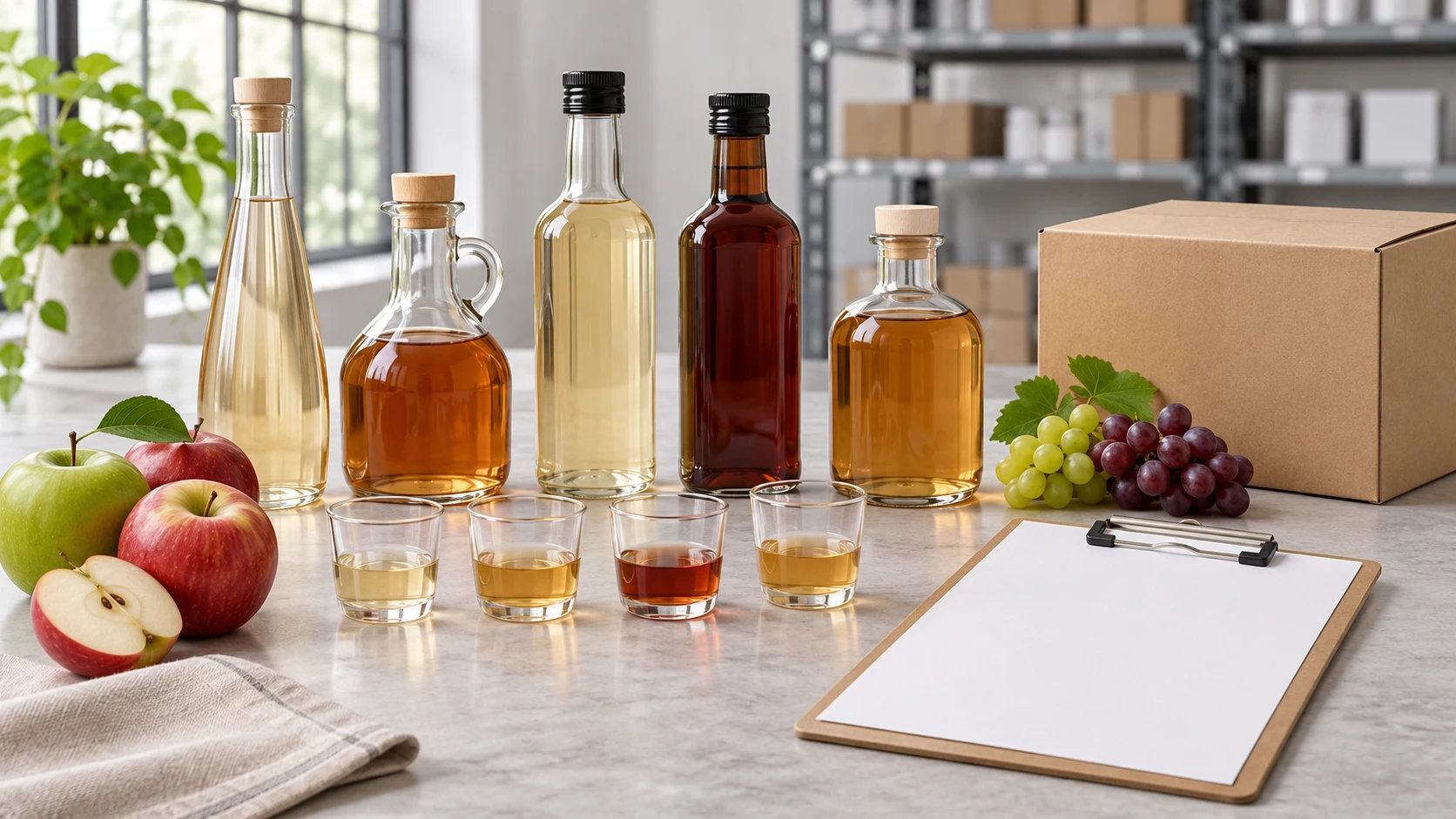
Request coded samples from the proposed recipe and pack. Record colour, clarity or intended haze, aroma, raw-material character, sharpness, aftertaste and any oxidation, mustiness or foreign note. Taste only under a controlled food-sample procedure; a photograph cannot show acidity, aroma or finish. Compare like with like and keep sensory preference separate from specification compliance.

State the target total acidity as acetic acid, permitted tolerance and referenced analytical method. Record sample temperature, preparation, replicate count and reporting units. pH and total titratable acidity are different measurements, so do not use one as an undocumented substitute for the other. If colour, density, soluble solids or alcohol residue is commercially important, define the method and acceptance rule rather than asking for “standard quality.” Retain the approved reference sample and link it to the recipe code.
Freeze the recipe, additives and destination label
Request a controlled ingredient list and recipe version showing the fermented base, water, permitted additions, flavours, herbs, fruit ingredients, colour or caramel where proposed, preservatives and sulphites. Regulation (EC) No 1333/2008 places vinegars and diluted acetic acid in food category 12.3 and permits additives only under the applicable entries and conditions. Check the actual recipe in the current Union list; do not copy an additive declaration from a different vinegar or market.
Regulation (EU) No 1169/2011 requires the mandatory food information for prepacked products. Its Annex II treats sulphur dioxide and sulphites above 10 mg/kg or 10 mg/l, expressed as total SO2 in the product as consumed, as substances causing allergies or intolerances. Review the food name, ingredients, emphasised allergen wording where applicable, net quantity, durability date, storage, responsible EU operator, nutrition information where required, lot code and destination-language text. Verify raw-material, origin, organic, “unfiltered” and ageing claims against the final product and evidence.
Verify fermentation control and lot traceability
Regulation (EC) No 852/2004 requires hygiene controls and HACCP-based procedures. Ask for a process flow covering raw-material receipt, alcoholic substrate control where relevant, acetous fermentation, blending, maturation, filtration, heat treatment where used, filling, closing, coding and release. The producer should define its own validated controls for the actual product and line; the buyer should not insert a generic fermentation time or temperature into the RFQ.
Request lot-level links between raw material, fermenter or batch, blend tank, processing records, packaging materials, finished-product tests and dispatch. Regulation (EC) No 178/2002 requires traceability through production, processing and distribution. Define change notification for the fermented base, recipe, processing site, filter, heat treatment, bottle, closure or label. A supplier address or fruit image does not prove raw-material origin or product identity.
Qualify the product-pack combination
Specify glass or plastic bottle, colour, nominal fill, neck finish, cap, liner, tamper evidence, label stock, case and pallet. Vinegar is acidic, so request food-contact documentation and compatibility evidence for the actual bottle, closure and liner under the intended shelf life and storage conditions. Regulation (EC) No 1935/2004 requires food-contact materials not to transfer constituents in amounts that endanger health, unacceptably change food composition or deteriorate organoleptic characteristics.
Run shelf-life work on the final recipe and pack. Review leakage, closure torque or agreed seal measure, panel or bottle deformation where relevant, colour and aroma change, sediment expectations, label adhesion, code legibility and case performance after transport simulation. Define how retained samples and complaints will be investigated. Do not treat a generic packaging declaration as proof for every cap, liner and bottle combination.
Send one comparable vinegar RFQ matrix
- Destination, channel, intended legal name, vinegar type, raw-material basis and flavour profile
- Recipe code, filtered or cloudy style, total acidity target, tolerance and analytical method
- Coded sample protocol, sensory attributes, reference sample and acceptance owner
- Ingredients, additives, sulphites, allergens, claims and permitted substitutions
- Destination artwork, language, responsible operator, nutrition, date and lot coding
- Process summary, traceability, food-contact file, shelf-life plan and change control
- Quantity by SKU, named delivery place, price basis, minimum order, lead time, validity and deviations
Require each bidder to complete the same matrix and list every exception. The export quote request guide structures commercial terms and included documents. Submit the controlled brief through the Marnivo inquiry form for a case-specific sourcing review.