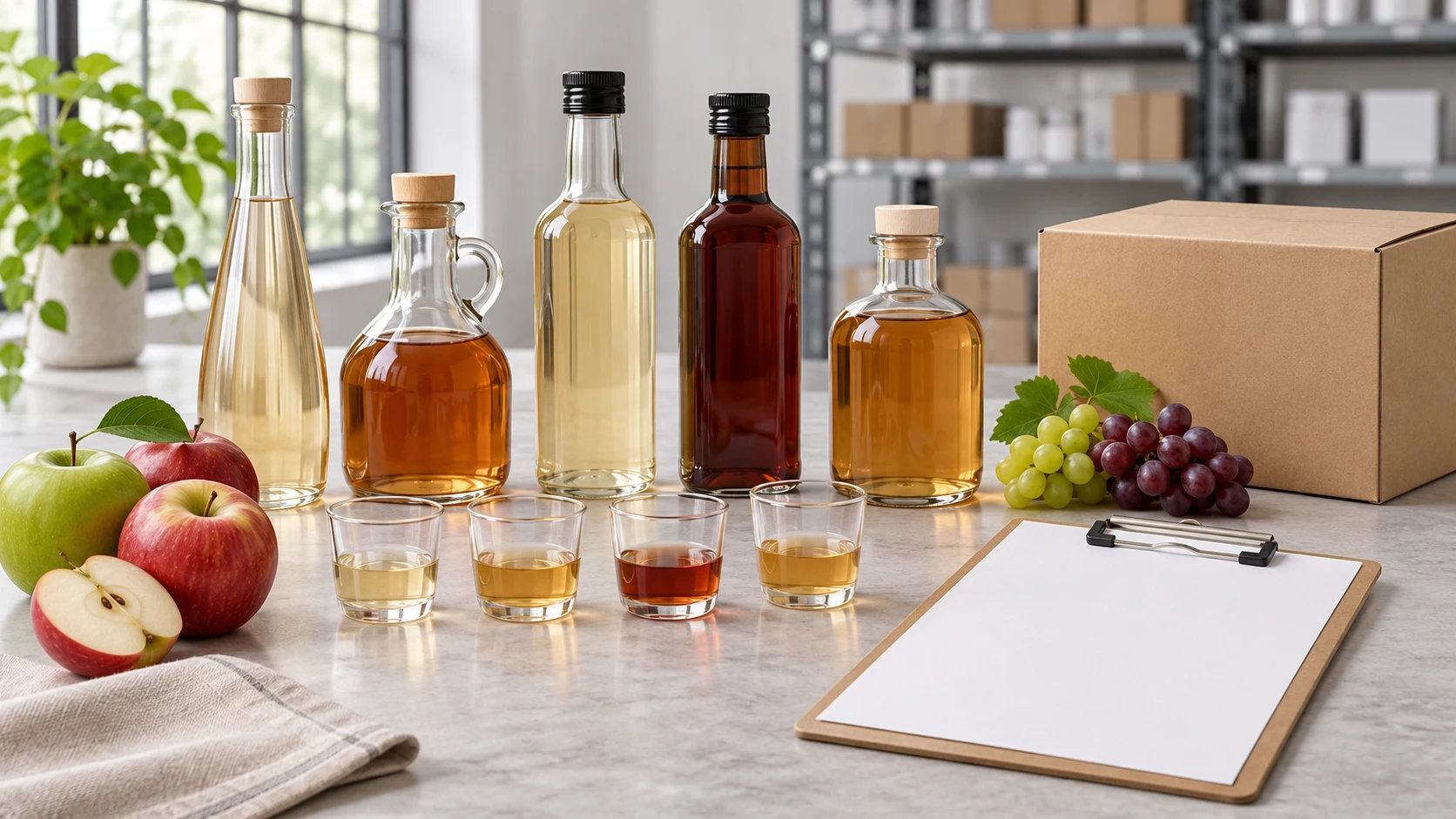
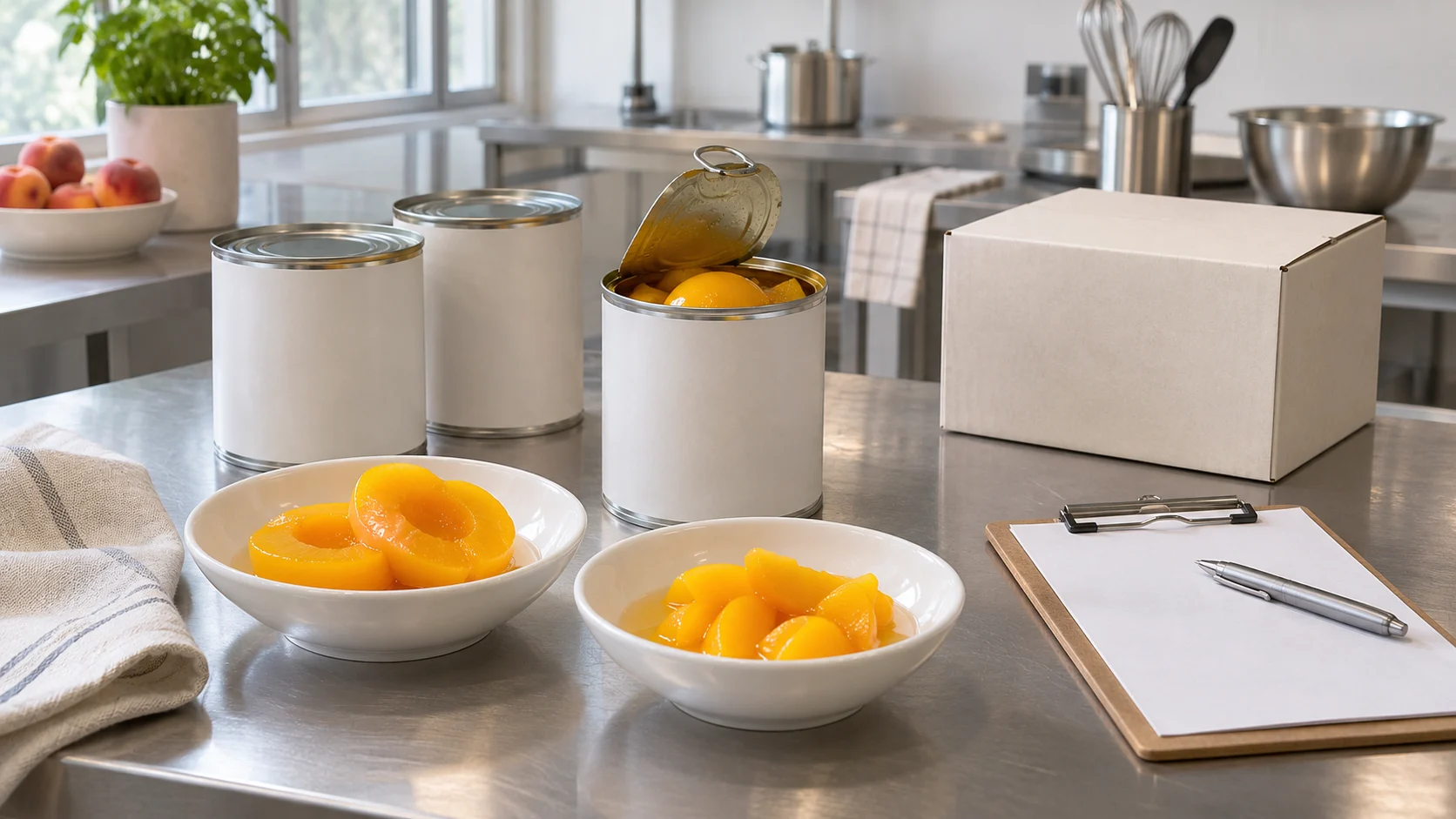
Define the peach and commercial format before requesting price
“Canned peaches” is not one comparable specification. State the destination, retail or food-service channel, can size, opening format, case configuration and expected use. Then define yellow- or white-flesh peach where relevant, clingstone or freestone if material to the offer, and the presentation: whole, halves, quarters, slices, dice or another agreed style. Specify whether the pack is in water, fruit juice, another agreed liquid medium or syrup, and describe the sweetness target without inventing a universal value.
Record the intended piece size, count range, colour, firmness and flavour profile, as well as permitted variation between crop lots. Decide who approves the fruit, packing medium, artwork, print proof and signed reference sample. The sauces and preserves buyer page frames the category, while the private-label workflow separates product, artwork and change approvals.
Standardise the sample and defect review
Use coded samples and one written preparation method. Record can condition and code, gross and net mass, packing-medium appearance and aroma before draining. After a controlled drain, assess piece count and size distribution, colour uniformity, ripeness, texture, flavour, peel, pit material, blemishes, bruising and broken pieces. Compare equivalent styles; a firm half and a soft dice serve different uses and should not share one score.
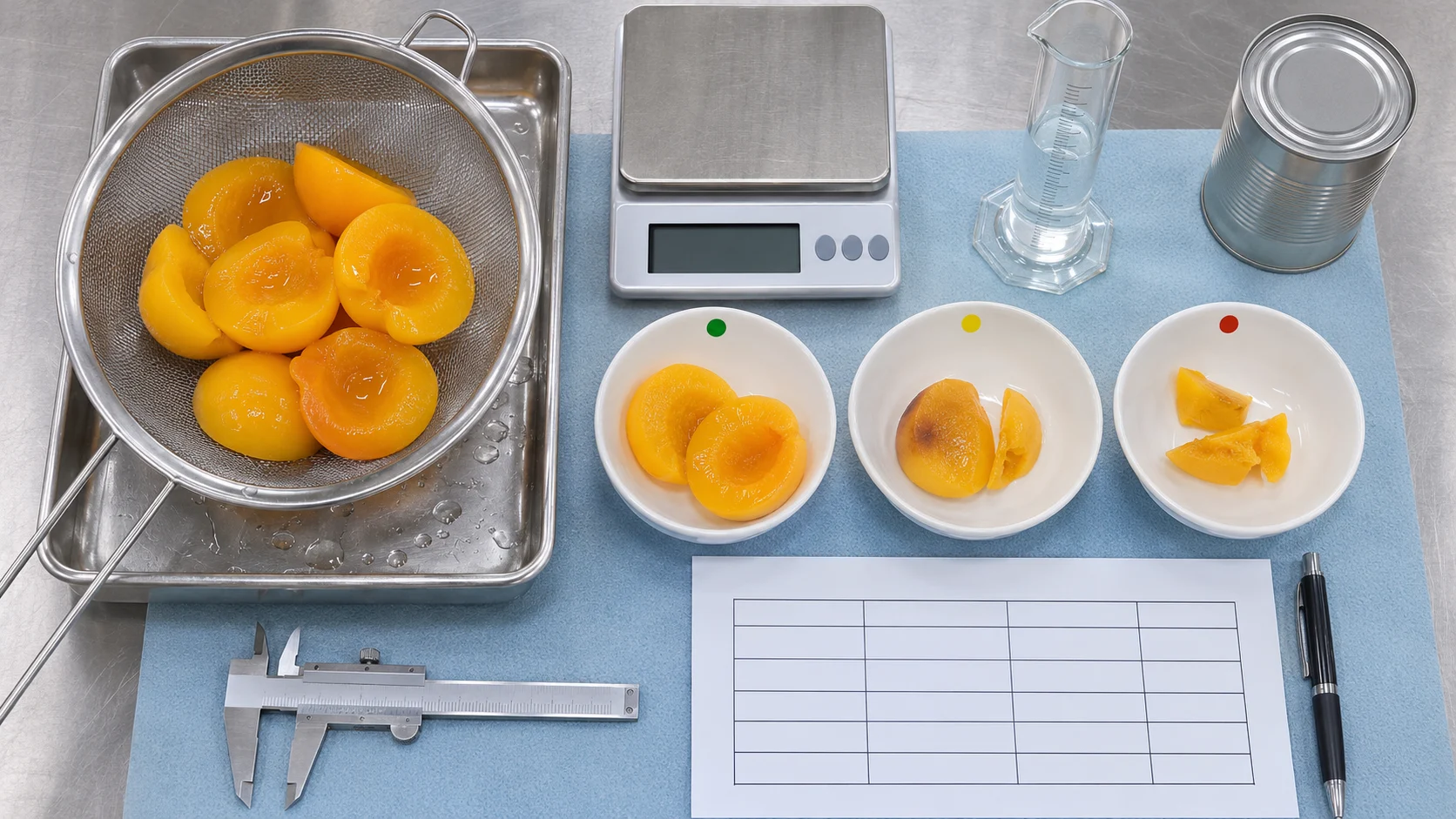
Codex CXS 242-2003 defines canned stone-fruit styles, packing concepts and quality criteria, including peach defect categories. Use it as a technical reference, then write the exact contractual method, sampling plan and acceptance rule for the intended market and pack. Do not convert a supplier photograph or one attractive can into evidence for every production lot. Keep sensory ranking, specification compliance and commercial evaluation as separate decisions.
Control net quantity and drained weight as different measures
Regulation (EU) No 1169/2011 requires the drained net weight when a solid food is presented in a liquid medium. The label therefore needs a controlled relationship between total net quantity and drained fruit quantity. In the purchase specification, state the declared values, tolerance basis and how they will be verified. Agree the scale, sample temperature, opening method, sieve or screen, drain time, inclination, sample number and calculation. Otherwise, two laboratories can report different results for the same can.
Link the weight check to fill control. Review fruit-to-liquid ratio, piece distribution, headspace, vacuum where applicable, closure condition and code legibility. Define action for an underweight unit, a lot average outside the agreed rule or excessive variation. A higher total fill does not compensate for insufficient drained fruit, and a compliant average should not hide damaged or leaking units.
Freeze the recipe, packing medium and destination label
Request the controlled ingredient list, recipe code and version, peach input specification, water or juice source, sugars or sweeteners, food acids, antioxidants, firming agents, flavours and any other additives. Regulation (EC) No 1333/2008 permits only listed additives under their applicable conditions of use. Check the proposed recipe against the current Union rules for the actual food category rather than copying an additive list from another canned fruit.
Review the food name, ingredients in descending order, allergens and cross-contact assessment, net and drained quantities, durability date, storage after opening, responsible EU food business operator, nutrition declaration, lot code and destination-language text. Verify any origin, “no added sugar”, juice-pack or nutrition claim against the final recipe and evidence. A Turkish supplier address does not by itself prove peach origin, additive compliance or label readiness.
Validate the heat process and the real can system
Regulation (EC) No 852/2004 requires food businesses to apply hygiene requirements and HACCP-based procedures. Ask for the flow diagram and control plan covering fruit receipt, sorting, peeling and pitting, cutting, filling, medium preparation, closing, heat processing, cooling, coding, release and traceability. The qualified processor must establish the safe scheduled process for the actual product, container and line; do not insert a generic time or temperature into the RFQ.
Specify can body, end, internal coating, easy-open feature where used, seam or closure checks, corrosion expectations, secondary packaging and pallet pattern. Regulation (EC) No 1935/2004 provides the general EU framework for food-contact materials. Request declarations and supporting evidence for the actual can, coating, lid and intended conditions of use. Shelf-life work should follow the finished product-pack combination and review sensory quality, container integrity, leakage, swelling, corrosion and code readability after transport and storage.
Send one comparable canned-peach RFQ matrix
- Destination, channel, peach type, style, piece size, packing medium, can and case
- Fruit specification, recipe version, additives, allergens and permitted substitutions
- Coded sample method, defect categories, texture and signed reference sample
- Total net quantity, drained weight, verification method, sampling and tolerances
- Destination label, claims, responsible operator, nutrition and lot coding
- Process-control summary, pack-contact file, closure checks, shelf life and traceability
- Quantity by SKU, named delivery place, price basis, minimum order, lead time, validity and deviations
Require each bidder to complete the same matrix and list every exception. The export quote request guide structures delivery terms and included documents. Submit the controlled brief through the Marnivo inquiry form for a case-specific sourcing review.