
Define the product and user before requesting a price
This brief assumes a cosmetic toothpaste intended to clean and care for teeth and the oral cavity. Start with the destination, sales channel, intended age group, flavour, colour, texture, foam level, sweetness profile, target use and pack size. State whether the concept is a standard fluoride paste, a children’s product or another clearly defined variant. Do not let a supplier infer the age group or claims from a reference pack.
Agree measurable sensory and physical targets: appearance, homogeneity, odour, taste, aftertaste, dispensing force and acceptable separation. A benchmark sample may explain direction, but it does not replace a controlled specification. The personal-care buyer page frames category questions, and the private-label workflow helps assign formula, artwork and release approvals. If proposed ingredients or claims may move the product outside the cosmetic framework, obtain destination-specific classification advice before commercial comparison.
Lock the formula, fluoride source and change control
Request the complete quantitative formula for the EU responsible person and safety assessor, plus the INCI list, raw-material specifications, flavour composition information needed for assessment, microbiological specifications and limits for relevant impurities. The safety file cannot rely on a partial formula. Identify permitted substitutions in advance because a new abrasive, humectant, surfactant, preservative, flavour or colour can affect safety, performance, labelling and stability.
The consolidated Regulation (EC) No 1223/2009 places conditions on fluoride compounds in oral products. For listed fluoride sources, the ready-for-use product is limited to 0.15 % calculated as fluorine, including combined permitted compounds. Toothpaste containing 0.1 to 0.15 % fluorine also triggers specified children’s wording unless it is already labelled as contraindicated for children. Confirm the actual fluoride source, total fluorine calculation, analytical method, release tolerance and warning with the responsible person; never copy a ppm value or warning from another formula.
Map the responsible person, safety file and notification
Before placing a cosmetic toothpaste on the EU market, the project needs an EU responsible person, manufacture in accordance with cosmetic good manufacturing practice, a cosmetic product safety assessment and product information file, compliant labelling and notification through the Cosmetic Products Notification Portal. Ask who performs each role, where the product information file is kept, which final formula and packaging the assessment covers, and how evidence will be updated after a change.
CPNP notification is not an approval, certificate or quality mark. It is a regulatory notification submitted by the responsible person, and in certain cases a distributor, under the cosmetics framework. Request the notification reference or controlled confirmation at the appropriate stage, but do not treat portal entry as proof that the formula, claims or artwork meet every obligation. Also agree serious-undesirable-effect handling, complaint escalation, batch traceability, retained samples and recall contacts.
Build evidence around the finished paste
Create a test plan for the finished formula rather than relying on raw-material brochures. Useful specification points can include appearance, homogeneity, pH where technically meaningful, viscosity, extrudability, density, flavour delivery, foam, cleaning performance, available fluoride where relevant, microbiological quality and package compatibility. Set methods, sampling, release limits and responsibility. Any abrasion or specialist performance target should use a method and acceptance criterion agreed for the intended product.
Run stability and compatibility work on the final toothpaste, tube, cap, seal and carton combination. Define storage conditions, checkpoints and acceptance criteria for separation, hardening or thinning, flavour change, colour, odour, fluoride performance where relevant, microbial quality, leakage, tube paneling, cap function and print or coding durability. Commission Regulation (EU) No 655/2013 requires cosmetic claims to be supported by adequate and verifiable evidence. Claims such as whitening, sensitivity relief, enamel repair or long-lasting protection need product-relevant substantiation and careful classification review; an ingredient story alone is not proof of the finished product claim.
Specify the tube, seal, coding and transport case
Define the tube material and barrier structure, dimensions, shoulder and nozzle, cap type, opening control, tamper-evident feature if used, crimp or end seal, decoration method, coding area and nominal content. Request drawings and compatibility evidence for the chosen formula. A visually similar tube can behave differently with flavour oils, surfactants or moisture over time, so artwork approval should follow pack-function review rather than replace it.
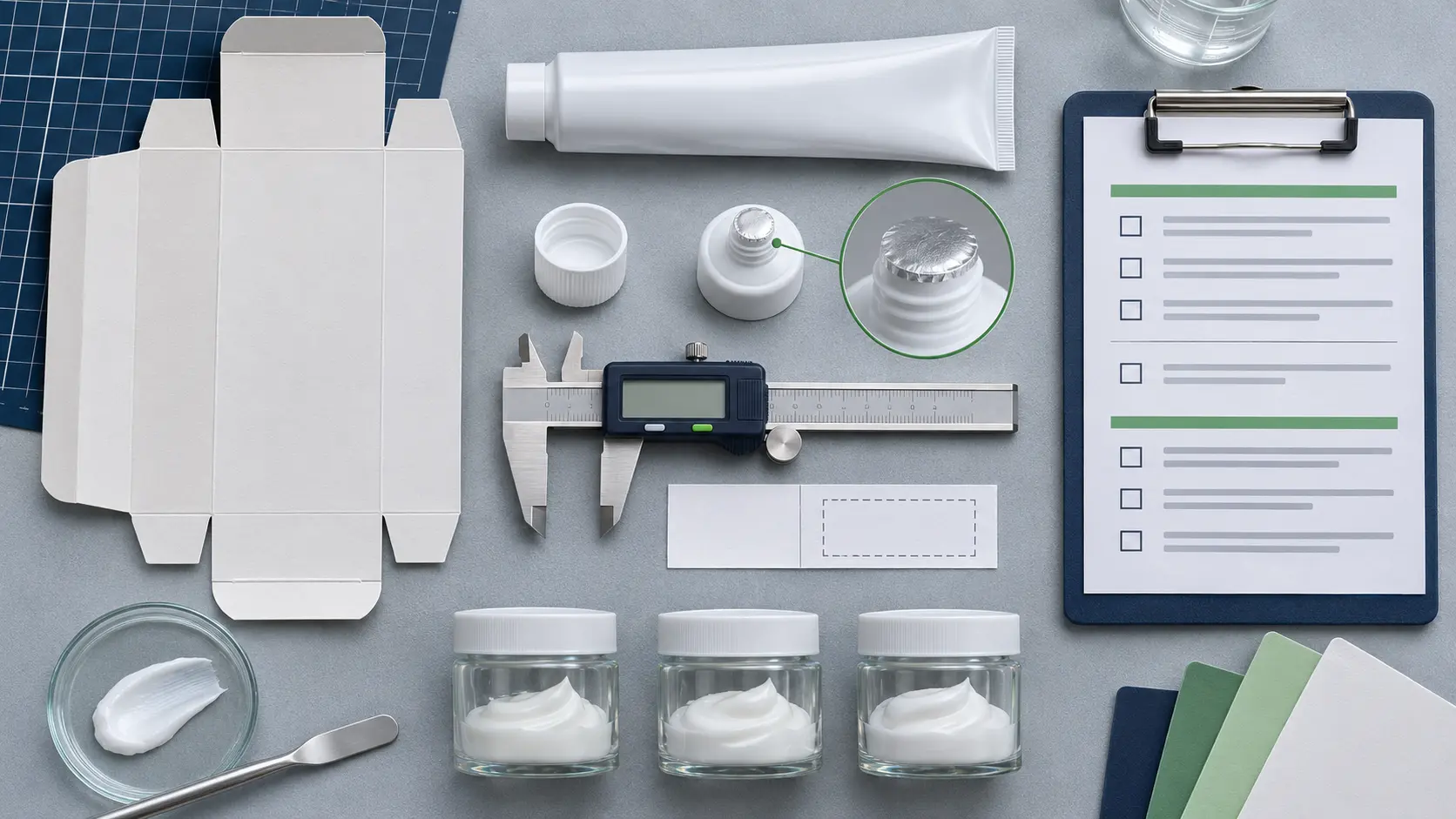
Agree leakage, seal, cap torque, dispensing and transport checks, together with case count, dividers, pallet pattern and expected route. Confirm how batch code and durability information remain legible on both tube and carton where applicable. Shelf-life evidence should cover the sale pack and planned distribution conditions. Accelerated observations can support the study, but they should not be presented as automatic proof of the declared life.
Send one comparable toothpaste RFQ
- Destination, channel, intended user, cosmetic function, flavour, colour, texture and nominal content
- Controlled quantitative formula, INCI list, fluoride source and total, raw-material specifications and substitutions
- Responsible person, safety assessor, product information file, good-manufacturing-practice evidence and CPNP responsibility
- Finished-product methods and limits for sensory, physical, microbiological and fluoride controls
- Stability and compatibility protocol for the final tube, cap, seal, decoration, coding and carton
- Destination-language label, warnings, claims, claim evidence, batch traceability and complaint route
- Sample plan, approval gates, delivery place, price basis, minimum order, lead time and exclusions
Require every bidder to complete the same sheet and keep technical acceptance separate from commercial comparison. Use the export quote guide to align delivery and price assumptions, then send the controlled brief through the Marnivo inquiry form for a case-specific sourcing discussion.