Define the fish, not only the sales name
“Private-label tuna from Türkiye” is not a complete buying unit. State the sales name, scientific species, presentation, covering medium, can format and destination. Separate the fish’s catch or farming information, processing country and final packing country. Packing in Türkiye does not by itself establish where the fish was caught.
Freeze the species and any permitted substitution in writing; species can change sensory profile, yield, contaminant assessment and commercial value. Record solid, chunks or flakes; tuna-to-medium ratio; water, brine, sunflower oil or olive oil; salt; additives; and relevant allergens or cross-contact. The food-products buyer page provides category context, while the private-label workflow assigns specification, artwork, sample and change approvals. Confirm availability, factory, minimum order, certifications, lead time and price only for the named offer.
Compare pack format and usable yield on one method
Ask for net quantity and drained net weight, not only the front-panel can size. Regulation (EU) No 1169/2011 requires drained net weight when a solid food is presented in a liquid medium. Define the buyer’s check method: sample temperature, opening, sieve dimensions, draining time, number of cans and treatment of broken pieces. Do not compare a single informal drain test with a supplier’s declared batch method.
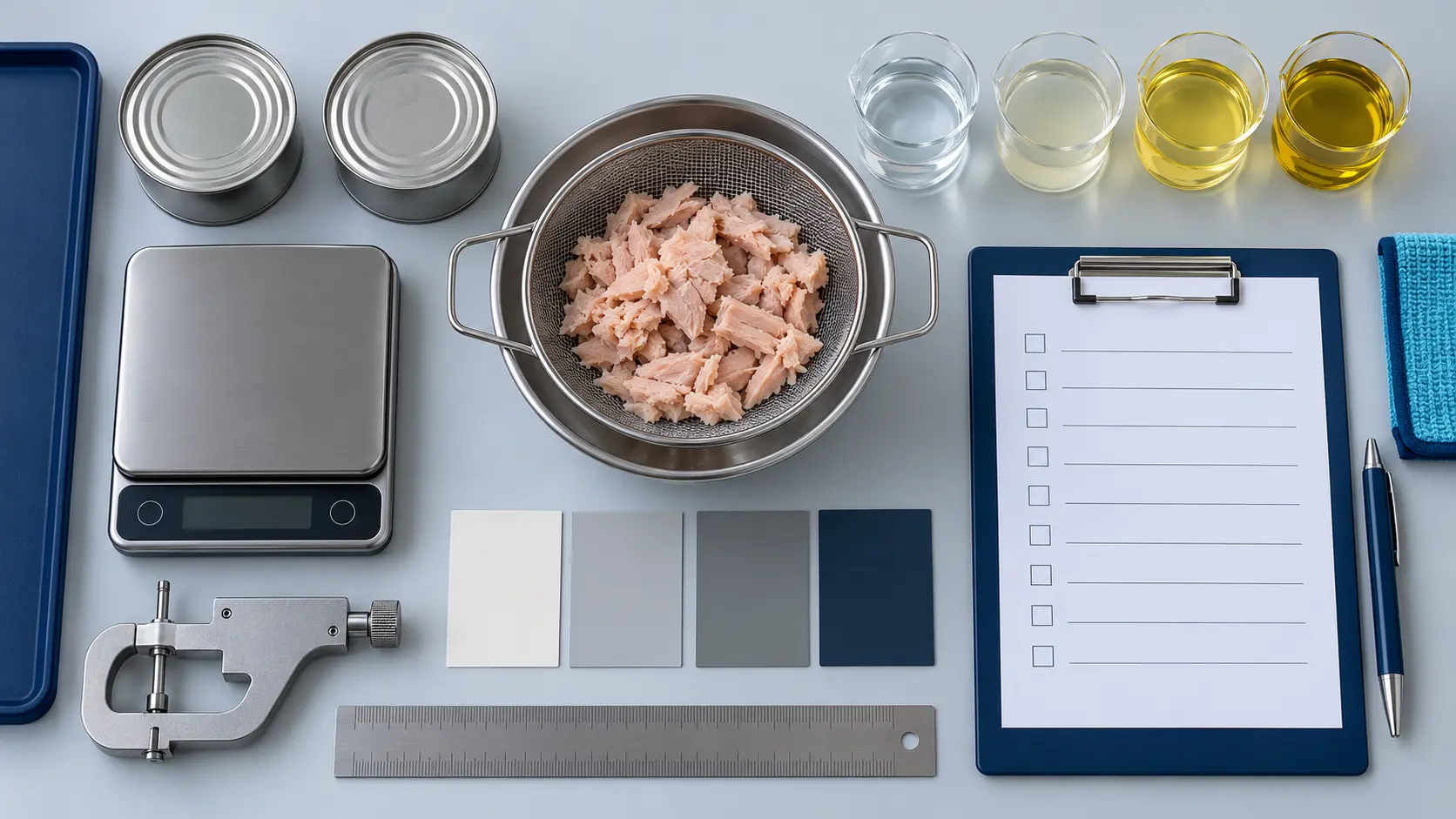
Approve the visual grade with retained samples. Specify piece size, colour, dark-meat allowance, bones, skin, blood spots, texture, odour and distribution of oil or brine without turning preference into a safety claim. Record tolerances and an acceptance plan across cans and cases. For illustration, 24 cans at 160 g net equal 3.84 kg net product per case; at 112 g drained per can they equal 2.688 kg drained fish. Compare quotations only when can count, net and drained weight, medium, grade and delivery basis match.
Connect the factory file to food safety and EU entry
Regulation (EC) No 853/2004 sets specific hygiene rules for food of animal origin. Request the actual establishment identity, approval details, product flow, HACCP-based controls, scheduled thermal process, retort records, cooling-water control, container integrity checks and written hold-and-release rule for the offered product. A generic certificate or a retort chart from another can size is not release evidence for the named lot.
Before commercial commitment, confirm the current EU entry route. The Commission’s non-EU establishment page explains that eligible animal-origin goods must come from listed countries and establishments; its certification page lists current model certificates. Check the exact country, establishment, product category, certificate, border-control and TRACES requirements; do not infer eligibility from a sample or brochure.
Build a lot-linked histamine and contaminant plan
Regulation (EC) No 2073/2005 includes histamine criteria for fishery products from species associated with high histidine. Have a competent adviser map the product and species to the applicable criterion. State who samples, how many units represent the lot, the method and laboratory scope, result interpretation, release authority and action after a non-conforming result. Cold-chain history before cooking still matters; a final heat process does not make incomplete raw-material controls irrelevant.
Regulation (EU) 2023/915 sets contaminant maximum levels, including mercury entries for fish. Do not copy a limit from another species: identify the exact tuna species and product category, then agree a risk-based plan with qualified regulatory and laboratory input. Link catch or aquaculture information, incoming lot, production code, test records, can code, case code and dispatch documents. Regulation (EC) No 178/2002 provides the general traceability framework.
Approve the real can, coating and destination artwork
Specify can dimensions, easy-open end, seam targets, internal coating, coding area, secondary pack and pallet. Request seam-teardown and leak-control records plus food-contact declarations for the actual can/end/coating system. The Commission’s food-contact materials page links the framework led by Regulation (EC) No 1935/2004. For BPA and other bisphenols, review the consolidated Regulation (EU) 2024/3190, including the 2026 correction and transitional provisions, against the actual coating and placing-on-market date.
Build artwork from the approved recipe and destination. Check legal name, ingredient order, allergen emphasis, net and drained quantity, responsible EU operator, date marking, storage after opening, nutrition, claims, origin presentation and destination languages. Verify lot identification under Directive 2011/91/EU. Validate shelf life and pack integrity on the approved fish, medium, can and thermal process; evidence from a different pack is not automatically transferable.
Send one comparable canned-tuna RFQ
- Sales name, scientific species, fish origin data, processing country and packing site
- Solid, chunks or flakes; covering medium, salt, additives and substitution rule
- Can size, units per case, net and drained weight, tolerances and check method
- Establishment and EU-entry review, thermal process, seam and release records
- Lot traceability, histamine and contaminant plan, laboratory and acceptance rule
- Can/end/coating file, artwork languages, shelf-life protocol and change controls
- Quantity, named delivery place, price basis, minimum order, lead time and validity
Require every bidder to mark deviations on the same sheet and keep commercial terms separate from technical approval. The comparable export quote guide structures inclusions and delivery terms. Share the brief through the Marnivo inquiry form for a case-specific sourcing review.