Define the product before requesting a price
Start with the food the buyer intends to place on the market, not a request for a generic can of corn. State whole-kernel sweet corn or another presentation, yellow or white colour, packing medium, recipe, net quantity, target drained weight, can size, destination and intended claims. Record the origin of the corn, place of processing and place of packing separately; a Turkish supplier address does not by itself prove every one of those facts.
Ask each bidder to complete one controlled specification covering variety or declared product identity, crop and lot references, kernel colour and tenderness, flavour, size distribution, broken or split kernels, cob, husk, silk and other foreign material, fill, headspace, packing medium, storage and shelf-life basis. The sauces and preserves buyer page places the item in the wider range, while the private-label workflow assigns artwork, sample and change-control responsibilities.
Make drained weight and defect limits measurable
The FAO/WHO Codex CXS 297-2009 Standard for Certain Canned Vegetables contains a sweet-corn annex covering identity, quality defects and minimum drained weight. It gives 61% for whole kernels with a liquid packing medium and 67% for vacuum-packed product or product without a liquid medium. Treat this as a transparent benchmark and specify the contract method, sample size, tolerances and governing market rules; a Codex value does not replace the buyer's agreed specification.

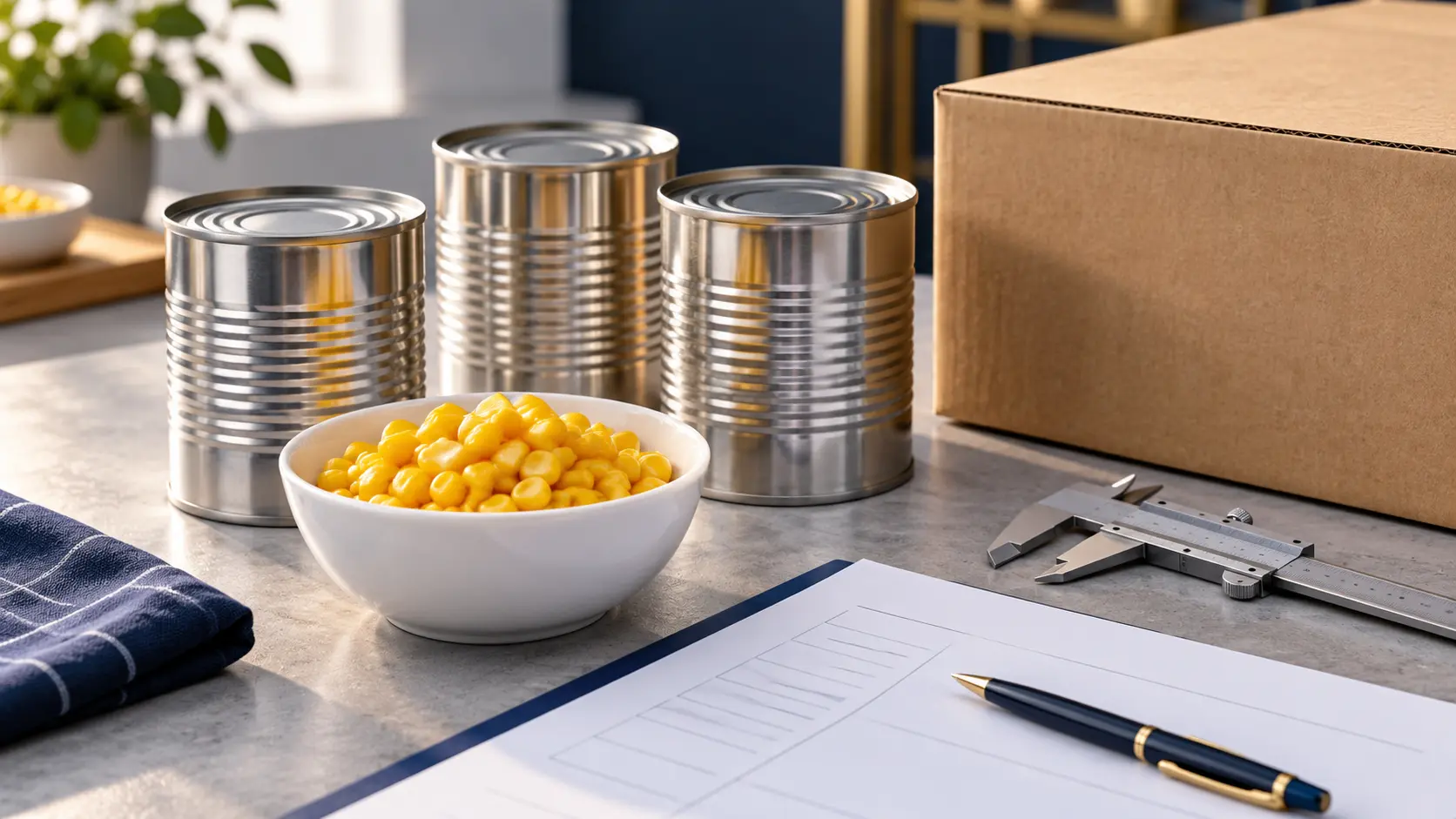
For sample comparison, use the same draining method, sieve, time and temperature for every can. Record net quantity, measured drained weight, kernel colour and texture, brine clarity, flavour and the count or mass of agreed defects. Keep individual-can results as well as the lot summary. An average can result must not conceal a short-filled unit, damaged seam or unacceptable foreign material.
Request process evidence for the production lot
Shelf-stable canned food depends on a validated product and container process, controlled execution and an intact closure. Ask the responsible manufacturer to identify the scheduled process authority or technical owner, critical factors, container format, line, monitoring records, deviation handling and release decision for the proposed item. Do not turn confidential process parameters into a marketing claim; confirm that the exact recipe, fill, can and line are within the evidence reviewed for the lot.
Regulation (EC) No 852/2004 requires food-business operators to apply hygiene requirements and procedures based on HACCP principles. For plant-origin raw material, build the analytical plan from current risk and destination rules. Check the exact commodity and active substance under the current consolidated Regulation (EC) No 396/2005, and confirm any applicable contaminant limits under Regulation (EU) 2023/915. Define sampling point, method, reporting limit, reviewer and response to a non-conforming result.
Approve the label and the real can together
Under Regulation (EU) No 1169/2011, prepacked food requires the applicable mandatory information. Its Annex IX also requires the drained net weight where a solid food is presented in a liquid medium. Review the legal name, ingredients, allergens if any recipe introduces them, net quantity, drained net weight, date marking, storage, responsible operator, nutrition information, instructions and destination language on final artwork. Verify origin wording and voluntary claims from evidence instead of inferring them from the supplier or brand.
Approve the food and pack as one system. Request the can and coating specification, closure dimensions, coding position, corrosion and damage criteria, case configuration and evidence for the intended food contact under Regulation (EC) No 1935/2004. Examine dents, flange damage, rust, leakage, swelling and seam condition on samples from the proposed line. Agree how non-conforming cans are isolated and how transport tests relate to the approved case.
Connect the approved sample to the released lot
Use three stages: selection samples, a sealed reference after recipe and pack approval, and first-production samples from the intended line. Record supplier, product code, raw-material lot links, can and end code, packing date, sample condition, drained-weight method, sensory result and reviewer. Define which measurable change triggers investigation, rejection or a documented concession.
Regulation (EC) No 178/2002 requires traceability through production, processing and distribution. Link corn lots, ingredients, cans, finished cases, checks and retained samples. Keep the finished-lot indication clear under Directive 2011/91/EU, and identify who can retrieve records and coordinate withdrawal or recall activity.
Send one comparable canned-corn RFQ
- Destination, channel, product identity, colour, origin wording, packing medium, recipe and proposed claims
- Kernel size and texture, broken-kernel and plant-material limits, net quantity and drained-weight method
- Can size, coating, seam and damage criteria, code format, case configuration and transport checks
- Process ownership, critical-factor monitoring, deviation handling, lot release and retained-sample plan
- Risk-based pesticide and contaminant scope with sampling point, method, reporting limit and reviewer
- Label language, legal name, ingredients, allergens, net and drained weight, date marking and operator
- Quantity, named delivery place, price basis, minimum order, lead time, validity and marked deviations
Require every bidder to answer on the same sheet and separate technical acceptance from commercial comparison. Use the comparable export quote guide for delivery terms and inclusions. Send the completed brief through the Marnivo inquiry form for a case-specific sourcing review.