Define the SKU before asking for price
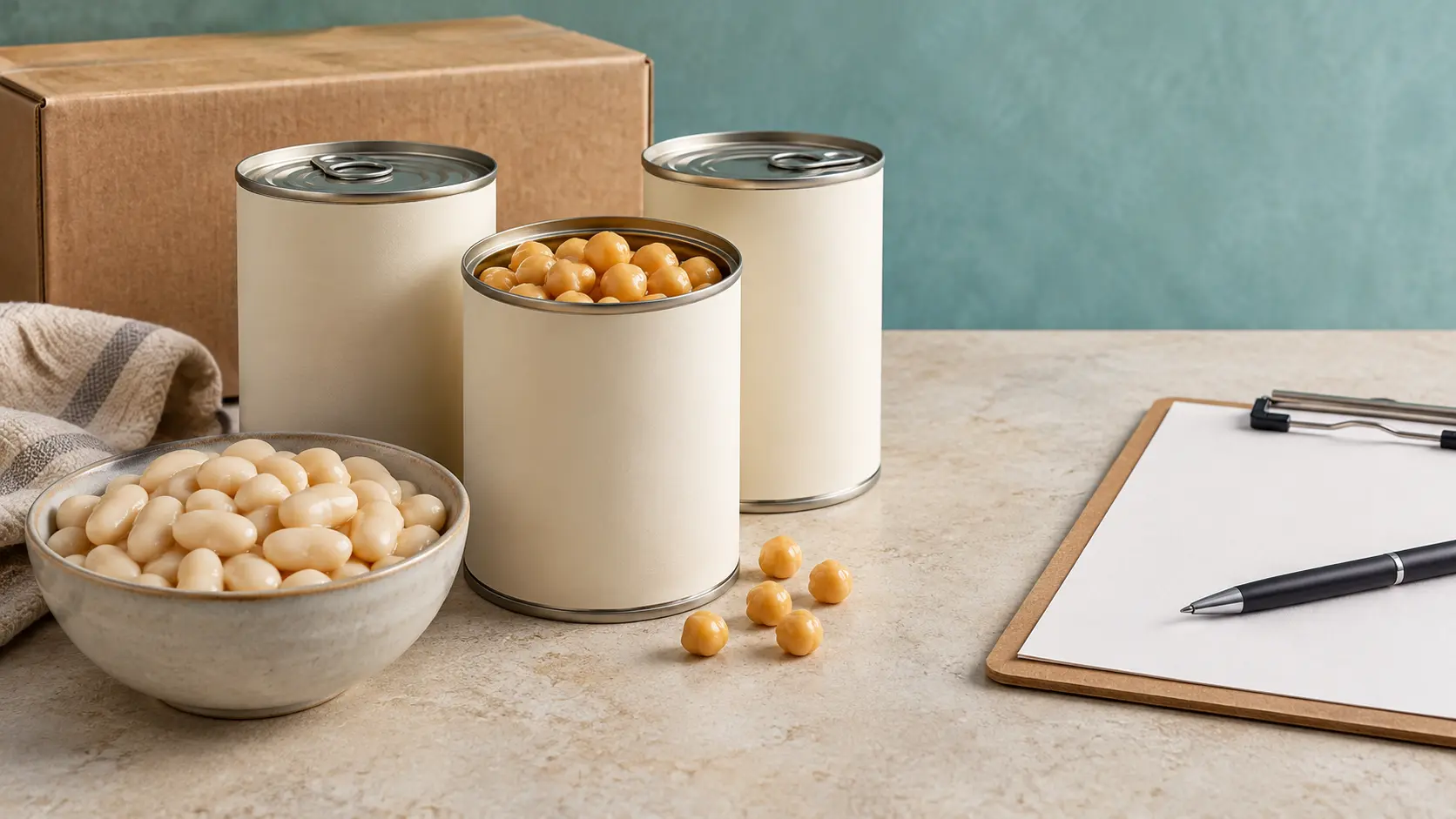
“Canned chickpeas” or “canned beans” is not yet a quotation unit. State the pulse species and variety where commercially relevant, target size or count range, colour, skin condition, firmness, flavour profile and permitted visual defects. Define whether the product is in water, brine, sauce or another covering medium, and whether salt, firming agents, antioxidants or other ingredients are acceptable. Give each recipe and can format its own SKU; a 400 g retail can and a food-service can should not share one specification.
Place the project within a relevant grocery staples buying programme, but keep product-level acceptance criteria separate. A catalogue image cannot confirm stock, minimum order, certification, origin, lead time or the exact recipe. Require every commercial point for the offered production site and SKU in writing.
Make drained weight comparable
Separate nominal net quantity from drained net weight. The first includes the food and covering medium; the second concerns the solid food after a defined draining procedure. In an EU retail project, Regulation (EU) No 1169/2011, Annex IX, requires drained net weight where a solid food is presented in a liquid medium. The exact product and medium still need destination-market review before artwork approval.
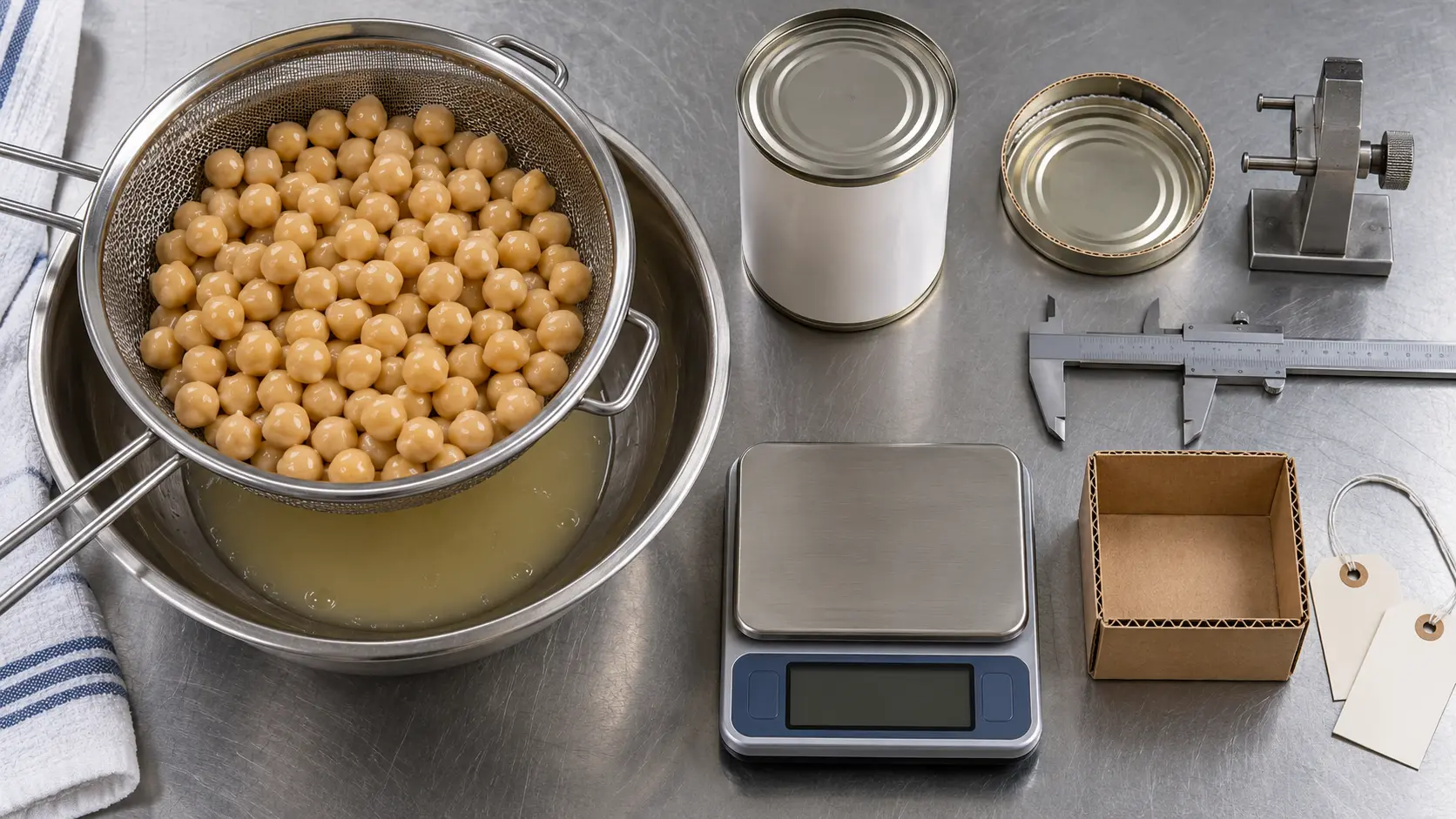
For supplier comparison, specify the test method instead of accepting a percentage without context. Record sample temperature, sieve or screen, drain time, whether the product is rinsed, number of cans, calculation and tolerance. Ask for individual results as well as the lot average. If one supplier quotes at packing and another quotes after storage, the figures may not be comparable because legumes and covering liquid can continue to exchange moisture.
Link process evidence to the offered product
Commercial sterility and shelf life depend on the actual product, container and process. Ask the manufacturer to identify the factory, line, can size, formulation, fill weight, headspace control, closure system and the validated thermal-process reference used for the offered SKU. Request records that show how critical parameters and deviations are controlled. Do not prescribe a universal time or temperature in the buying brief: viscosity, particle size, pH where relevant, container geometry and equipment can change the required process.
Regulation (EC) No 852/2004 provides the EU hygiene framework and requires food businesses to apply HACCP-based procedures. A buyer should still obtain product-specific evidence: current specification, process or shelf-life basis, finished-product release checks, complaint and recall route, and lot traceability. Under Regulation (EC) No 178/2002, traceability must connect suppliers and customers; your file should also connect raw-material lots, packaging lots, production code and finished cases.
Approve the can and transport pack
Lock the can material and dimensions, internal coating reference, easy-open or standard end, coding area and intended storage conditions. Ask for food-contact compliance documentation appropriate to each material and market. Regulation (EC) No 1935/2004 requires food-contact materials not to endanger health, unacceptably change food composition or deteriorate organoleptic properties under normal or foreseeable use; it also establishes traceability principles for those materials.
Agree practical inspection points: dents, paneling, rust, leakage, double-seam condition, label adhesion, code legibility and case damage. Define units per case, dividers or trays, gross weight, carton dimensions, pallet pattern, stretch wrap and stacking limit. Review the retail can and export carton together, then run transport testing that reflects the intended route. A satisfactory bench sample does not prove that a full pallet will arrive without abrasion or deformation.
Build the EU label file from verified data
Start artwork only after the recipe, legal name and quantities are stable. For EU prepacked food, Regulation (EU) No 1169/2011 supplies the core mandatory particulars, including the food name, ingredients, allergens, net quantity, date marking, storage or use instructions where required, responsible food business operator and nutrition declaration. Drained net weight should be reconciled with the approved method and specification rather than copied from a competitor.
Confirm destination languages and any national presentation requirements with the responsible importer. Check origin statements, nutrition values and claims against the exact recipe and evidence. “No added salt”, “high protein”, organic, vegan, origin and similar statements should remain proposed claims until the responsible operator verifies the legal conditions and supporting file. Use the private-label workflow to assign ownership for recipe approval, translation, dieline, barcode, print proof and change control.
Send one comparable buyer checklist
- SKU, destination country, pulse type, size or count range and sensory target
- Covering medium, complete recipe, nominal net quantity and drained net weight method
- Can format, end type, coating reference, code position and food-contact documents
- Factory, line, thermal-process reference, lot traceability and release evidence
- Defect limits, sample plan, shelf-life basis and required remaining shelf life
- Case, pallet and transport-pack configuration
- Label languages, artwork owner and proposed claims
- Requested volume, Incoterms® rule and named place, timing, price, minimum order and quotation validity
Ask every bidder to complete the same sheet and mark deviations explicitly. Align delivery terms and exclusions with the comparable export quote guide. Price, availability, minimum order, certification and schedule remain supplier- and order-specific until confirmed. The Marnivo inquiry form can be used to share the destination, SKU and pack brief for a case-specific review.