Define the finished offer before requesting a price
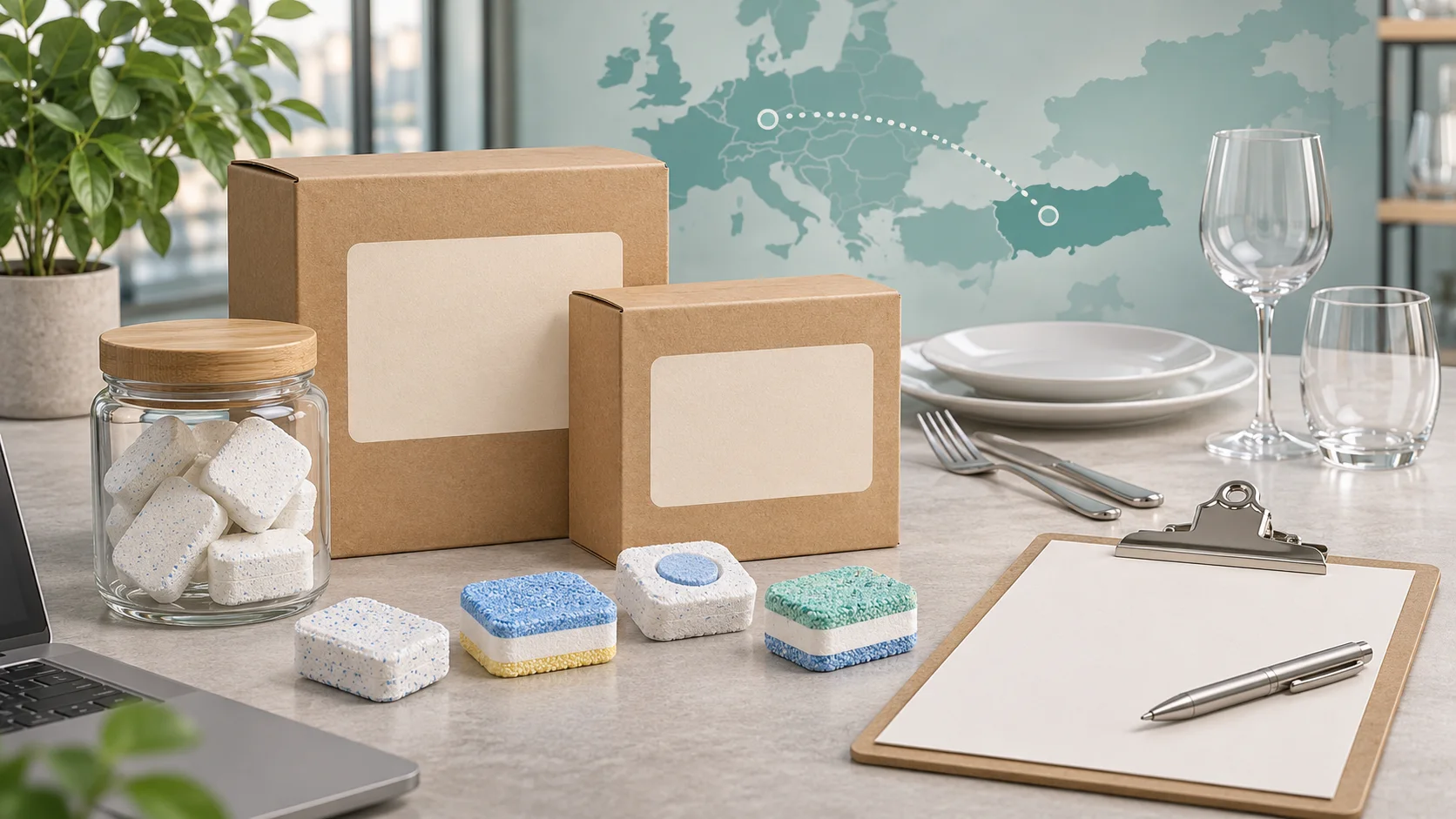
An automatic dishwasher tablet is a formula, a dose and a protective pack—not a generic cleaning unit. State the destination countries, retail or professional channel, machine and cycle assumptions, water-hardness range, normally soiled tableware definition, fragrance position and pack count. Decide whether the offer is a single-layer tablet, multi-layer tablet or another unit-dose format, and whether a water-soluble wrapper is part of the design.
Use a benchmark only to describe expected handling and cleaning behaviour; do not ask a supplier to copy another brand. The cleaning-products buyer page frames the category, while the private-label workflow assigns responsibility for specification, formula, artwork, samples and changes.
Lock the tablet specification and change control
Ask for the formula code and revision, tablet mass and tolerance, dimensions, layer construction, colour and fragrance, wrapper material, dissolution conditions, active-component ranges relevant to classification and detergent disclosure, and every substitution that needs buyer approval. A tablet with the same shape can behave differently when builders, enzymes, bleaches, surfactants or binders change.
Define physical release checks such as unit mass, dimensions, hardness or friability method, chipped-unit limit, appearance, odour and pack count. Link the approved sample, production recipe, safety data, label draft and finished-product specification to one revision. Request a documented change-notification rule for raw-material supplier, grade, process, tablet geometry, wrapper and pack construction.
Compare performance with one written method
Build a repeatable wash protocol before comparing samples. Record dishwasher model and loading pattern, programme, temperature, water hardness, dose, rinse-aid and salt settings, standard soil types, soil ageing, number of repeats and scoring method. Evaluate removal of relevant soils, glass spotting and filming, stainless-steel appearance, tea or starch residues, redeposition, odour and undissolved material. Results from different machines or programmes are not directly comparable.
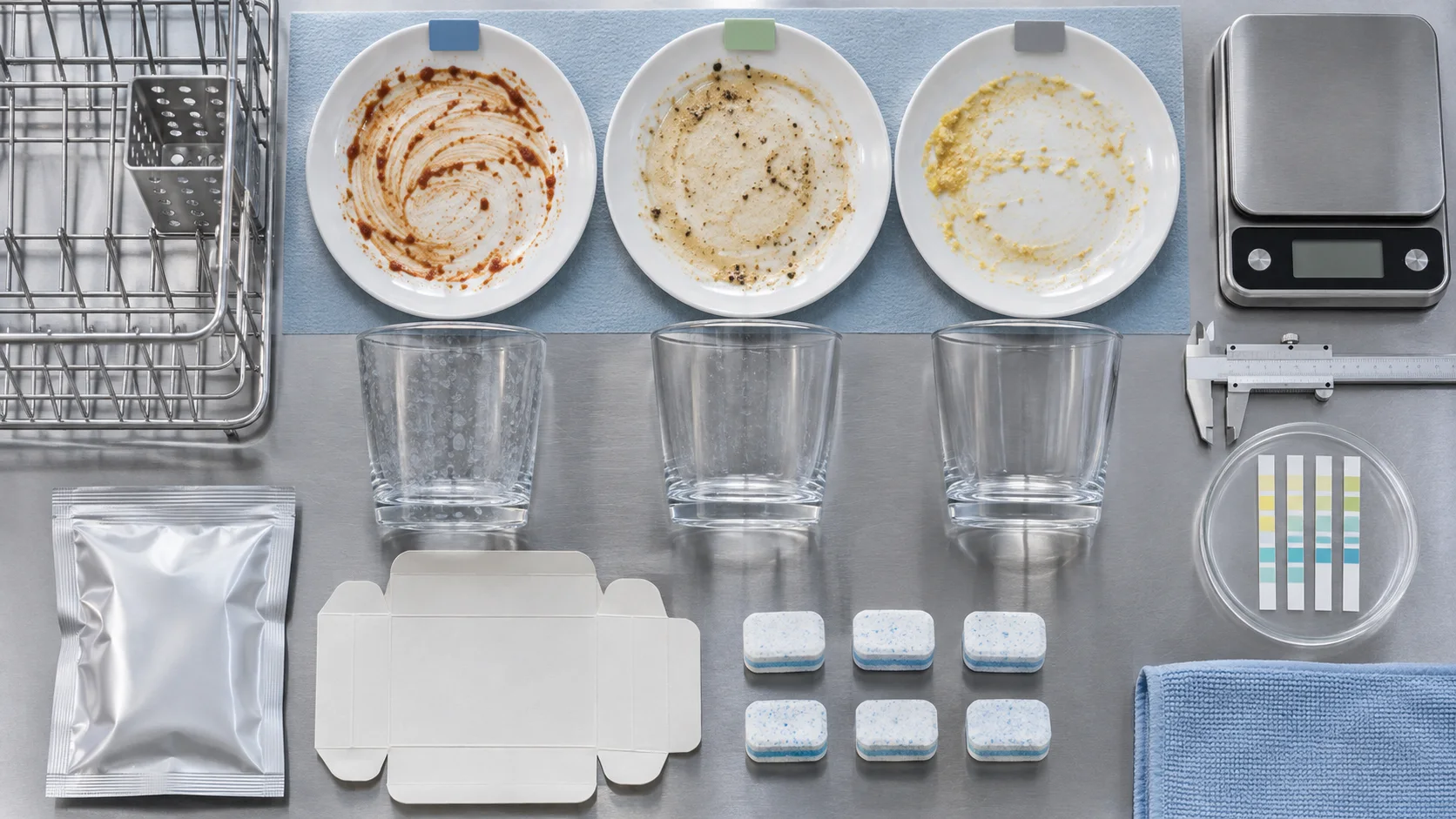
Include low-temperature or short-cycle work only when those uses are part of the brief. Test the final tablet and wrapper after defined storage, because moisture exposure can change tablet strength, dissolution and appearance. Keep internal comparative testing separate from advertising claims: a claim such as all-in-one, eco, plastic-free or suitable for a named cycle needs its own evidence and legal review.
Build the EU file for the launch date
For a 2026 EU launch, assess the final product under the current Regulation (EC) No 648/2004 on detergents. Consumer automatic dishwasher detergents must contain less than 0.3 grams of total phosphorus in the standard dose, and the consumer pack must state the standard dose in grams, millilitres or number of tablets for normally soiled tableware in a fully loaded 12-place-setting dishwasher, with water-hardness provisions where relevant. Tie that declaration to the offered tablet mass and formula rather than copying another label.
Regulation (EU) 2026/405 replaces the current detergent framework but generally applies from 23 September 2029. Treat it as a dated transition project for economic-operator roles, digital product passport data, label records and formula information; it is not a reason to skip the rules applying to the 2026 launch.
Document the final mixture classification under CLP Regulation (EC) No 1272/2008. Classification determines any pictograms, signal word, hazard and precautionary statements and packaging features. If the mixture is classified for health or physical hazards, confirm the responsible EU notifier, poison-centre notification and UFI before placing it on the market. ECHA notes that each UFI is linked to one mixture composition; do not reuse a code from another fragrance or formula.
Validate moisture protection, unit access and artwork
Specify the immediate wrapper or pouch, carton or tub, closure, barrier construction, count, tamper evidence, coding area, case and pallet. Run storage and distribution trials on the filled pack: moisture ingress, seal integrity, tablet breakage, wrapper blocking or dissolution, count accuracy, opening and reclosing, label adhesion and code legibility. Record conditions, sample size, acceptance limits and investigation owner.
CLP packaging must contain the product securely and must not resemble food, feed, medicine or cosmetics in a way that could mislead consumers. Child-resistant fastenings and tactile warnings are triggered by specified classifications or substances, not by a blanket rule for every tablet. Base the design on the documented classification, then review tablet access and household-use risks as part of the pack assessment. Build destination artwork from the released formula, detergent disclosure and CLP decision, including required languages and UFI where applicable.
Send one comparable RFQ matrix
- Destination, channel, unit-dose format, machine and cycle assumptions, water hardness and pack count
- Formula revision, tablet mass and tolerances, layers, wrapper, component ranges and change-control rules
- Physical release checks, signed sample, stability conditions and retained-sample plan
- Wash protocol, soil set, repeats, scoring, dissolution and spotting or filming limits
- Current detergent file, phosphorus result, 2029 transition owner, CLP decision, SDS and PCN/UFI status where applicable
- Immediate and outer packaging, moisture and transport tests, destination artwork and approval responsibility
- Quantity, named delivery place, price basis, minimum order, lead time, offer validity and deviations
Ask every bidder to complete the same matrix and keep technical approval separate from commercial comparison. The comparable export quote guide structures delivery terms and inclusions. Submit the controlled brief through the Marnivo inquiry form for a case-specific sourcing review.