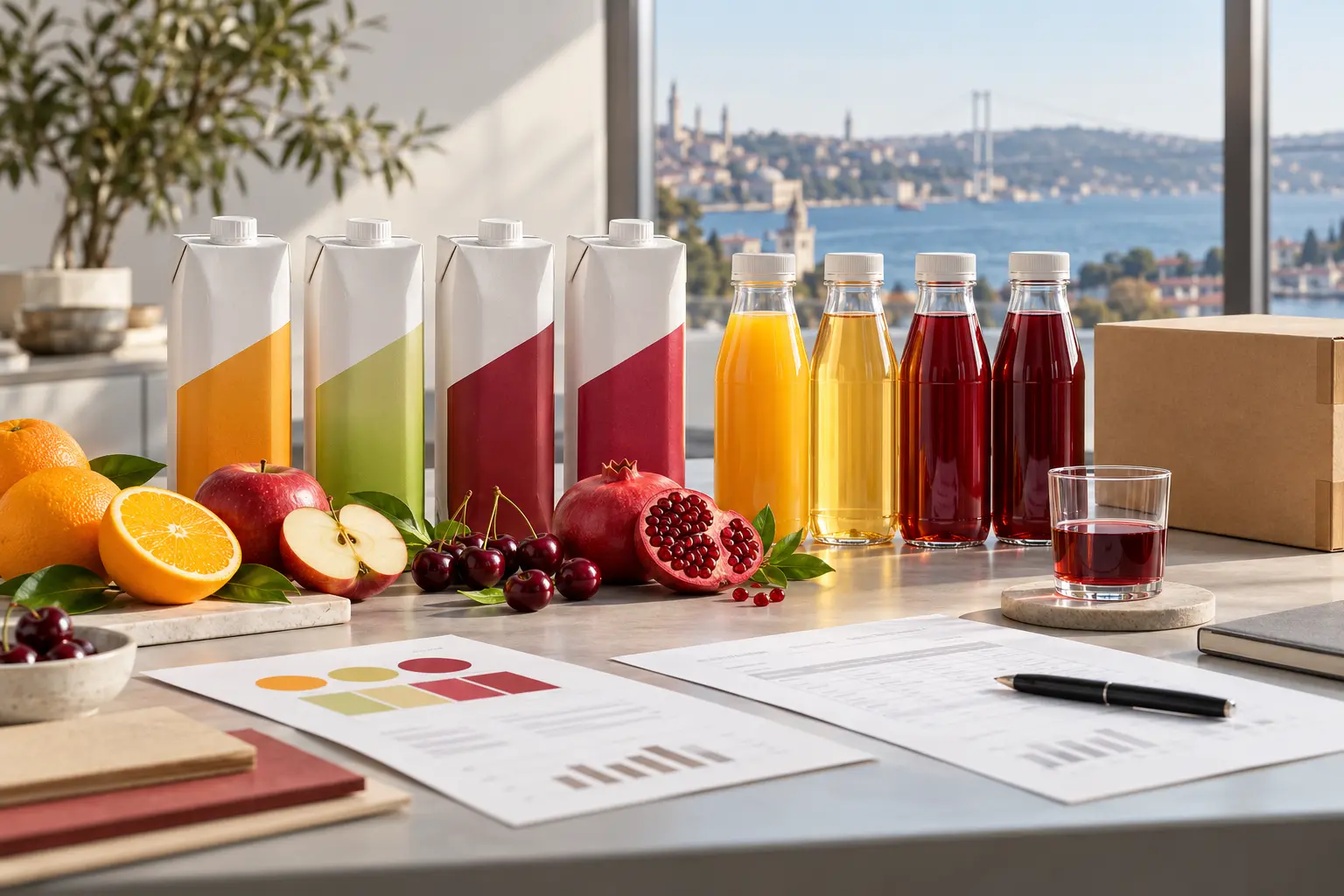
A shelf-stable drink described casually as ‘juice’ can be fruit juice, fruit juice from concentrate, fruit nectar or another beverage. Those names are not interchangeable in an EU purchasing file. The importer should connect the legal product name, recipe, nutrition and claims, destination label, heat process, pack construction and commercial offer to one finished SKU. This guide focuses on non-alcoholic fruit juice and nectar intended for retail sale in the EU; it is a buying framework, not a substitute for product-specific legal review.
Fix the legal product identity first
Start with the current consolidated EU fruit juice Directive, which includes the amendments applying from 14 June 2026. Ask the supplier to state the proposed legal name, fruit species, whether the product is direct juice or from concentrate, and whether it is a nectar. Record every fruit percentage in a blend and the intended Brix or other compositional reference. For nectar, confirm the fruit content and any sweetening ingredients against the rules for that fruit and recipe.
Do not turn a commercial phrase into a legal name. ‘Pure’, ‘natural’, ‘no added sugar’ and reduced-sugar wording each need a separate evidence and label review. The Commission explains that nutrition claims are permitted only under defined conditions; its nutrition claims page is a useful official entry point. Ask which claim is proposed, the precise basis for it and which finished-product data support it. Our beverage buyer page helps frame the category, but it is not proof that a specific SKU is available or suitable.
Build a formula and quality specification
Request a controlled specification with the finished-product code, ingredient list, fruit sources, juice or purée percentages, concentrate and reconstitution details, permitted additions, target soluble solids, acidity or pH range, sensory description, microbiological criteria, fill volume, storage conditions and declared durability. The specification should identify the test method, acceptance range and party responsible for release. A generic certificate or a laboratory sheet for another flavour does not close the file.

Link a dated recipe to a representative sample and pilot or production reference. Agree how colour, flavour, sediment, separation and pack appearance will be judged throughout shelf life. If the supplier changes a fruit source, concentrate, sweetener, vitamin, aroma, process or pack component, require a documented review before reusing the old label, nutrition declaration or shelf-life conclusion. For own-brand projects, the private label process provides a practical ownership map for recipe, artwork and approvals.
Approve one destination-ready label
The current consolidated Food Information to Consumers Regulation sets the general EU food-information framework, while the juice Directive adds product-specific naming and composition rules. Build an artwork checklist for the actual destination countries: legal name; ingredient list where required; emphasized allergens if present; net quantity; durability date; storage and use conditions; responsible food-business operator details; origin information where applicable; nutrition declaration; lot identification; and the mandatory language or languages for each market.
Reconcile the label with the signed recipe and analytical values. Check that front-of-pack fruit pictures, percentages and claims do not suggest a composition the specification cannot support. Confirm how the date and lot will be printed on the chosen pack, which surface carries each mandatory item and whether minimum font-size and legibility rules are met. Obtain written approval of the final print proof rather than accepting a low-resolution mock-up.
Connect shelf life to the exact pack
An aseptic carton, PET bottle or glass bottle is part of the product system. Record material structure, barrier assumptions, closure, tamper evidence, headspace, fill process, case configuration and intended storage and transport conditions. The European Commission’s food-contact-materials overview explains the general EU framework, traceability and supporting documentation. Ask for declarations and supporting evidence that match the actual food, contact conditions and pack components; do not accept a declaration for a different material as a substitute.
Review shelf-life work against the final recipe, process and packaging. Capture the sample or batch code, production date, test plan and acceptance criteria. Shelf-stable does not mean every recipe and pack has the same durability. Temperature, light, oxygen barrier and closure performance can affect quality, so record the validated conditions and remaining shelf life required at dispatch.
Compare quotations on the same basis
Issue the same SKU table to every candidate: legal name, recipe version, pack size and material, cap, label format, units per case, pallet pattern, destination, required remaining shelf life and requested delivery basis. Ask for the minimum order for that exact configuration, sample route, production lead time, quotation validity and which technical documents are included. Price, stock, minimum quantity and certification are supplier-specific facts and must be confirmed in the written offer.
Request the Incoterms® rule, version and named place, then separate product, packaging, freight, customs, testing, translation and artwork costs. Compare cost per identical litre and trading unit, not merely the carton price. The comparable export quote guide gives a reusable request structure.
Use a release gate before ordering
Release production only when one file contains: legal product identity; approved recipe and specification; claim support; representative sample reference; agreed quality methods and limits; finished label in every destination language; nutrition and compositional evidence; food-contact documentation for the exact pack; process and shelf-life basis; case and pallet data; change-control responsibility; quotation validity; and named delivery place. The importer should also complete destination-specific import, tax, deposit-return and recycling checks with the relevant authorities or advisers. A disciplined gate prevents a technically acceptable sample, attractive design and cheap quotation from belonging to three different products.